
She Walks in Beauty
by: Lord Byron (George Gordon)-1814

She walks in beauty, like the night
Of cloudless climes and starry skies;
And all that’s best of dark and bright
Meet in her aspect and her eyes;
Thus mellowed to that tender light
Which heaven to gaudy day denies.

One shade the more, one ray the less,
Had half impaired the nameless grace
Which waves in every raven tress,
Or softly lightens o’er her face;
Where thoughts serenely sweet express,
How pure, how dear their dwelling place.

And on that cheek, and o’er that brow,
So soft, so calm, yet eloquent,
The smiles that win, the tints that glow,
But tell of days in goodness spent,
A mind at peace with all below,
A heart whose love is innocent!
It is said Lord Byron wrote these words after meeting the wife of his first cousin at a party in London. Byron was so struck by the woman’s beauty that the next morning he penned the poem. Anne Beatrix Wilmot-Horton, the “beauty”, was dressed in mourning clothes, and yet Byron saw her peaceful radiance to be in sharp contrast to the dark and somber dress she wore.
When in university, as an English major, I studied classic literature and romantic poetry. I memorized Byron’s poem and analyzed it thoroughly. When Mrs. Wilmot-Horton’s portrait was shown to our class, I laughed when my professor remarked that “beauty is indeed in the eye of the beholder”, since it was obvious that what Byron was enamored by was not the woman’s outward beauty per se, but her inward beauty. There must have been an ethereal quality to her that he found captivating. Personally, I couldn’t see it myself.
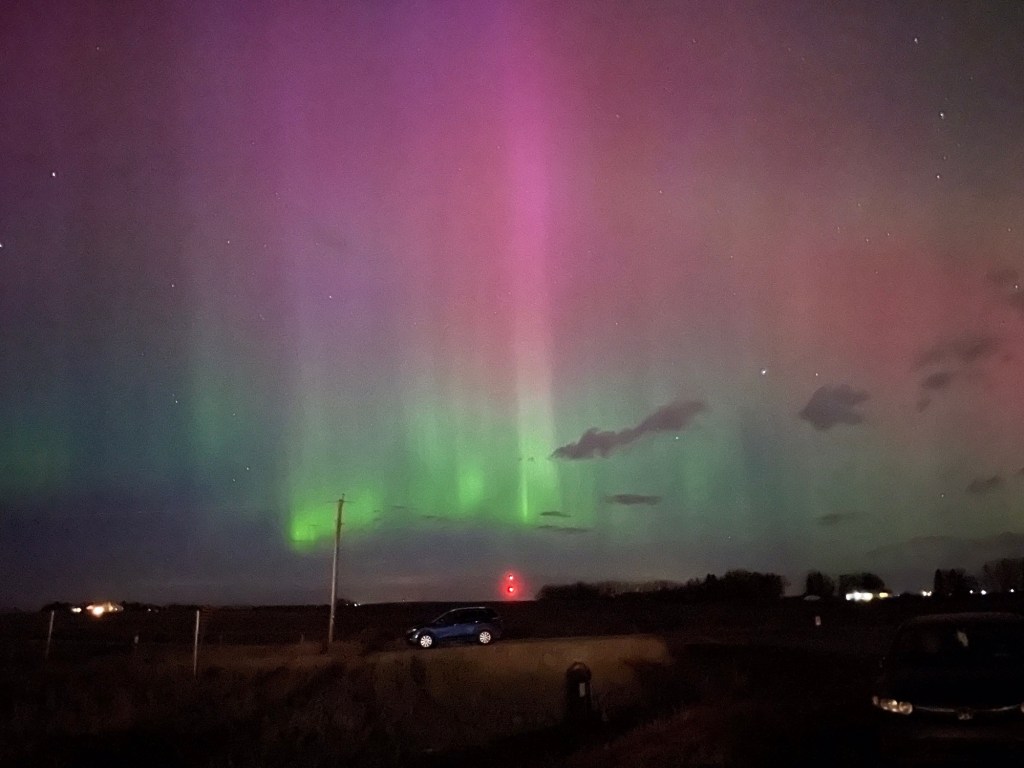
However, as I gazed heavenward last night, I suddenly understood Byron’s poem in new light (so to speak). I silently, mouthed the words, “She walks in beauty, like the night…” awestruck by Lady Aurora pirouetting magnificently across the sky.
We have been blessed with a spectacular display of the Aurora Borealis for several nights here in Southern Alberta. Last night, I was absolutely mesmerized by the colours and the constant movement illuminating the darkness.
As a writer, I don’t focus on the impersonal science behind the phenomenon. Physicists may marvel that solar explosions produce huge quantities of particles thrown into deep space causing the electrically charged Aurora, but my mind is excited by the myths and legends that spark the imagination. Is it any wonder I choose to call the display, “Lady Aurora”, and I give her an ethereal quality with a perplexing form when she cavorts in regal beauty amongst the stars?
It is part of Aurora‘s “charm” that she has multiple personalities; the Ancient Greeks naming her “Sunrise” and Boreas meaning “Wind”. The Romans claiming her sisters were Helios (the Sun) and Seline (the Moon) and that Aurora raced across the morning sky in her “multi-coloured chariot to alert her siblings to the dawning of a new day”. (The Aurora Zone)
Ancient peoples around the world tried to explain the unusual and rare Aurora lights by creating epic legendary battles between good and evil enacted in the heavens. As a writer, these stories capture my interest and fuel my imagination to explore further the brilliance of Aurora in all her forms.
Last night, as Lady Aurora walked in beauty, in starry skies above me, the poetic words of Byron could not adequately express how wonderstruck I was at the sight. Only the sublime words of the Psalmist directed my eyes away from the creation itself to focus entirely on the Creator. Science, myths, legends, or my wild imagination cannot explain, fathom or comprehend how our God brought the expanse of the Universe into being and then how He Masterfully painted Aurora in all her splendour in the firmament.
To God Be the Glory, Great Things He Hath Done!







 Lynn Dove's Journey Thoughts
Pingback: Word Award Winner | Lynn Dove's Journey Thoughts